


What's New

Deploying CTD (Photo: Sharon Walker)
During a recent multidisciplinary expedition (February 9 - March 5), NOAA PMEL scientist Sharon Walker traveled aboard the New Zealand research vessel Tangaroa to the Brothers submarine volcano. The cruise went from Wellington to Tauranga, NZ, and included scientists and technicians representing various fields from New Zealand, Italy, UK, and U.S.
The expedition’s goal was to image the volcano's magma/melt regions and hydrothermal pathways using 25 seafloor Ocean Bottom Electro-magnetometers (OBEM) for passive and controlled-source electromagnetic (CSEM) measurements. Essential data collected will test hypotheses on processes supporting distinct vent fields and mineral deposit formation. Additional work included repeat magnetic and gravity surveys, hydrothermal plume mapping for output changes, dredging for volcanic history, and multibeam mapping... more
Research Sites

Honors
NOAA Distinguished Career Award 2019: EOI's Robert Embley
NOAA's Team Player of the Month: EOI's Susan Merle! See NOAA-PMEL's awards site.
Feature Publication
Search all PMEL publications
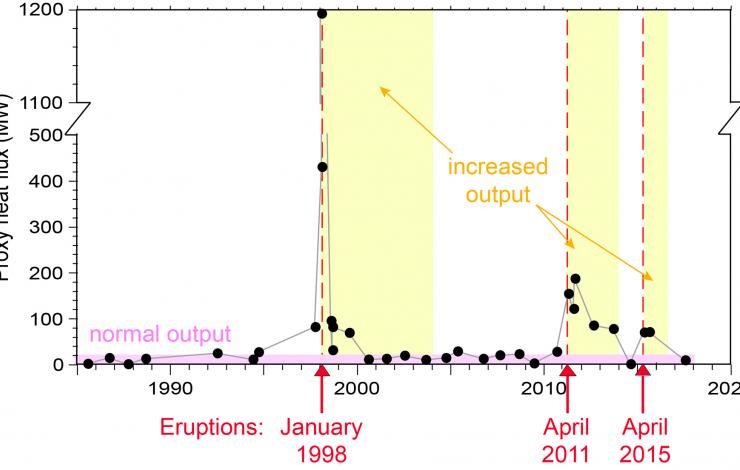
Estimates of hydrothermal heat flux (MW) for the 33-year time series (black dots; note break on the vertical axis). Pink band at bottom shows "normal" heat flux averaging ~15 MW. Yellow bands show intervals of increased heat flux following eruptions (red triangles and dashed lines), which reached values as high as 1200 MW. About two-thirds of the total heat flux occurred during the 10 years shown by the yellow bands.
About 80% of volcanic activity on Earth occurs on the deep seafloor of the global ocean. These eruptions are concentrated where the Earth’s tectonic plates... more