


Weather and Climate Research for Wildland Fire Management
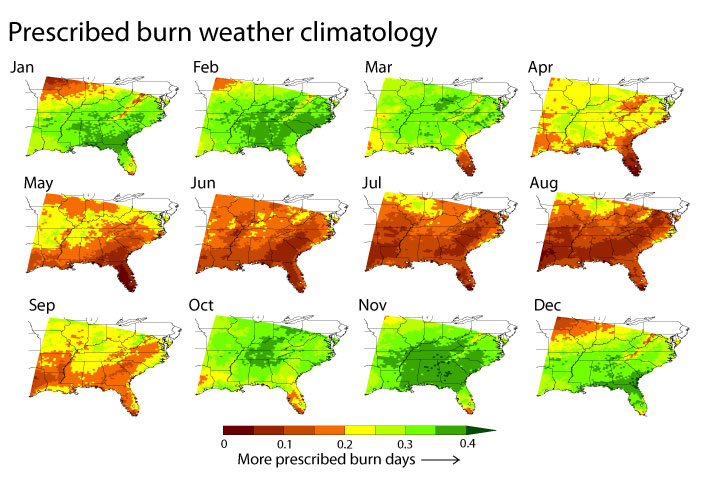
Prescribed fire treatment is an essential management tool for reducing hazardous fuel levels. It is also critical for restoring and maintaining fire-adapted forests, such as those found across the southeastern U.S., where most prescribed burns in the U.S. take place. In order for prescribed burns to be both safe and effective they must be applied within a precise window of weather and fuel moisture conditions. Many land managers would like to increase the use of prescribed fire treatments, but they often cite a major impediment: the weather window for prescribed burning is too short, narrow, or unpredictable. This project works to reduce weather impediments to prescribed burning by better understanding the weather opportunity for prescribed burning and its predictability. We also conduct research on outstanding questions about aspects of weather and climate variability that have impacts on wildland fire management efforts.
Prescribed Fire and Smoke Planner
Decision support systems for wildland fire management
In collaboration with the U.S. Forest Service AirFire Research Team and the University of Washington School of Environmental and Forest Sciences (SEFS), scientist Andy Chiodi (Cooperative Institute for Climate, Ocean, & Ecosystem Studies at NOAA PMEL) led the development of the Prescribed Fire and Smoke Planner—a tool that analyzes weather model output to determine when prescribed burn days are most likely to occur. When the user specifies the location and weather constraints needed to achieve the desired fire behavior and smoke management, the Planner mines historical records to provide information about how many days are likely to be available for burning at a given time of year and identifies the most restrictive weather and fuel parameters. Over selected regions, the Planner also allows managers to track burn opportunities over the coming days using tailored, real-time, weather forecasts.

PI: Andy Chiodi