
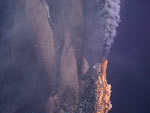
Hydrothermal Venting
Hydrothermal venting occurs when seawater penetrates into the ocean crust, becomes heated, reacts with the crustal rock, and rises to the seafloor as fluid and gas. VENTS studies the hydrothermal fluids and gas that are found at vents and in the surrounding seawater.
Hydrothermal Venting Research Groups:
Studying hydrothermal vents as the interface between the hot, anoxic upflow zone and cold, oxidized seawater.
Studying the effects of hydrothermal venting on the oceans. At the broadest scale, we are studying the circulation of the deep and
intermediate waters of the Pacific Ocean.
Plume studies have been conducted on the Juan de Fuca Ridge each year since the inception of the EOI Program.
Assessing the effects of submarine
hydrothermal venting from Juan de Fuca and East Pacific Rise ridgecrest systems on the ocean chemistry of
the Pacific Ocean.
Bringing analytic and numerical models to bear on the understanding of physical, chemical, and sedimentological processes active at or near ridge crest spreading centers.
Highlights:
NOAA Research: Meet the Scientist, Sharon Walker
"Finding the Fire Beneath the Waves" documents Oceanographer Sharon Walker's career with PMEL's Earth-Ocean Interactions Program. Read more here.
Global Hydrothermal Vent Locations
A searchable database for more than 550 confirmed and inferred hydrothermal vent sites. The data set was compiled by Stace Beaulieu (WHOI) using lists maintained by Mark Hannington (University of Ottawa, Canada), Ed Baker (NOAA/PMEL, USA), and Sven Petersen (IFM-GEOMAR, Germany). (Read more)